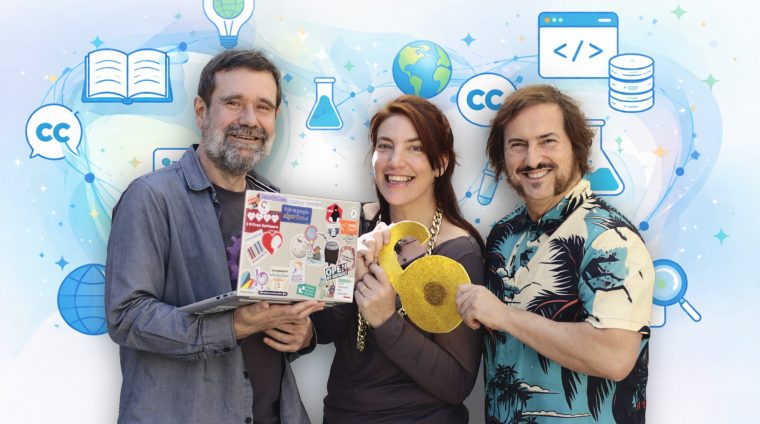


Jesus M. Gonzalez Barahona
Rey Juan Carlos University
Coordinator of the Office of Free Knowledge and Culture at URJC, and Professor of Telematics Engineering. He has worked at Rey Juan Carlos University since 1999. He holds a degree in Engineering and a PhD from the Polytechnic University of Madrid, and previously taught at Carlos III University of Madrid. His research focuses on the empirical analysis of software development, particularly through quantitative methods and data visualization in virtual and augmented reality. He has led more than 35 research projects, many of them international, and has a substantial body of scientific publications. In the field of education, he has over three decades of experience in networks, data transmission, and telematics services, among other topics.

Florence Claes
Rey Juan Carlos University
Academic Coordinator of Free Culture at Ofilibre. Full Professor at Rey Juan Carlos University, she has also taught at Nebrija and Isabel I Universities. During her doctoral studies, she collaborated with Complutense University of Madrid. She is the principal investigator of the Consolidated Teaching Innovation Group InnovaWiki, a member of the Ciberimaginario high-performance group, and has been a member since 2021. Her research focuses on online communities, Wikipedia as a collaborative space for knowledge creation, social networks, and digital opinion leaders. She has participated in international conferences and has over 30 scientific publications.

Tomás Zarza Núñez
Rey Juan Carlos University
Academic Coordinator of Open Access Publications at Ofilibre. With a PhD in Fine Arts from the Complutense University of Madrid (UCM), he is a tenured professor of Audiovisual Technologies and Projects, coordinator of the Drawing department, and has 28 years of university teaching experience. His career combines teaching, research, management, curating, and artistic creation focused on image, visual culture, technology, and artistic projects. He investigates personal memories, the use of images online, veracity, visual fraud, and artificial intelligence. He coordinates the MECA and CUVPAC research groups, has published over 20 scientific papers, participated in more than 70 exhibitions, and developed projects with highly relevant national and international institutions and companies.
- 6 Sections
- 74 Lessons
- 30 Hours
- Module 1: Free Licenses and Open Access13
- 1.1Learning guide.
- 1.2Presentation
- 1.3Discussion
- 1.4Objectives and contents
- 1.5How a free license works
- 1.6What are licenses? Definitions
- 1.7What is free culture?
- 1.8Main types of licenses
- 1.9License traffic light
- 1.10How are construction projects licensed?
- 1.11What should I do if my license is not respected?
- 1.12Situation at URJC
- 1.13Discussion about free licenses
- Module 2: Open Science13
- 2.1Learning guide
- 2.2Open Science Presentation
- 2.3Introduction to Open Science
- 2.4Origins
- 2.5Definition and concept
- 2.6Open Educational Resources
- 2.7Quality control mechanisms
- 2.8Evaluation of the evaluation activity
- 2.9Infrastructure for open science
- 2.10Citizen science
- 2.11Aspects of citizen science
- 2.12Open science policies
- 2.13Open discussion about science
- Module 3: Open Publishing13
- 3.1Learning guide
- 3.2Open publication presentation
- 3.3How to publish in open access
- 3.4Verification of ownership and permits
- 3.5License choice
- 3.6Marked as the chosen license
- 3.7Publication.
- 3.8What happens next?
- 3.9The case of the videos and audios
- 3.10The case of Free Software
- 3.11The Data Case
- 3.12Situation at URJC
- 3.13Discussion about open access publishing
- Module 4: Reuse of open source material12
- 4.1Learning guide
- 4.2Presentation “Reuse of open source material”
- 4.3Motivation.
- 4.4Practical matters
- 4.5Sites where you can find free works
- 4.6How to cite reused materials.
- 4.7Search for free images
- 4.8Search for free audio
- 4.9Search for free videos
- 4.10Searches for various types of free works
- 4.11Sites with other specific types of free works
- 4.12Discussion about reusing open source material
- Module 5: Free Software10
- Module 6: Open Data13
- 6.1Learning guide
- 6.2Presentation
- 6.3Discussion
- 6.4Objectives and contents
- 6.5How a free license works
- 6.6What are licenses? Definitions
- 6.7What is free culture?
- 6.8Main types of licenses
- 6.9License traffic light
- 6.10How are construction projects licensed?
- 6.11What should I do if my license is not respected?
- 6.12Situation at URJC
- 6.13Discussion about free licenses